Green Transformation
A path-based product site that helps Polish companies navigate green energy — and meet incoming EU regulations — without knowing the category first.
Context
The client is the leasing arm of a major Polish bank. Their existing site sold leasing products to people who already knew what they wanted — a forklift, a fleet vehicle, photovoltaics. But a new market was forming around it: thousands of mid-market Polish companies suddenly needing to act on ESG, driven by incoming EU reporting requirements and rising energy costs. Those companies weren’t shopping for products yet. They were trying to figure out what they even needed.
The business asked for “a green energy section.” What they actually needed was a different kind of site entirely — one for users earlier in the journey.
The problem
Green transformation is a confusing category. Photovoltaics, heat pumps, energy audits, white certificates, EV charging, decarbonisation plans — most decision-makers at small and mid-sized companies can’t tell which of these solves their actual problem. A standard product catalogue assumes they already know. They don’t.
The user isn’t shopping for a heat pump. They want to cut costs or cut emissions. Everything else is a means to that end.
That reframe became the spine of the project. Sell paths, not products.
My role
I was the lead UX/UI designer. I owned the end-to-end product design — IA, flows, wireframes, UI, design system extensions — working day-to-day with the business stakeholders, a supporting UX/UI designer, a product manager, and the dev team. Content was provided by the client’s marketing team; I shaped the structure those words sat inside.
What I did not own: brand identity (the client’s existing design system), the underlying product offerings, or the editorial copy.
Process
Committing to the two-paths model
The “reduce costs” vs “reduce CO₂ emissions” split came from the business in the first workshop. It was the right reframe — it organised the offering around what the user is actually trying to do, not what the client happens to sell. The work wasn’t in questioning that decision; it was in executing it.
The harder questions were the ones we actually argued about: how prominent to make the path selection (behind a quiz, above the fold, or the whole homepage), how to make each path feel substantively different rather than the same content with a different label, and how the choice would translate into product, knowledge, and partner experiences downstream.
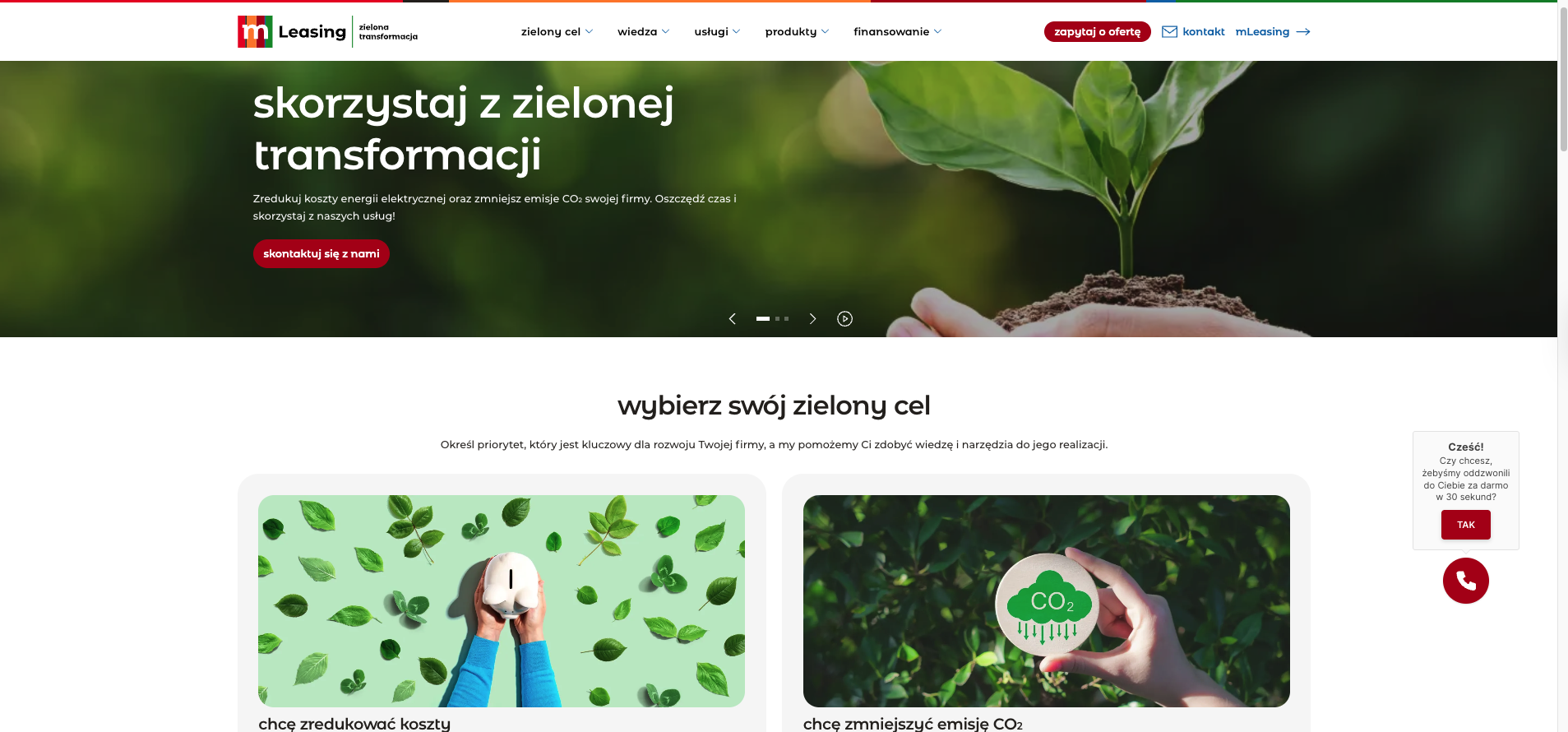
The path selection became the homepage’s primary job. The hero leads with brand and intent; the path selection is the first interactive moment; everything below it is context. The site doesn’t try to be everything before the user has chosen.
Mapping the journey end-to-end
Once we’d committed to the model, the next step was mapping what each path actually contained. Through workshops with the business and stakeholder partners, I mapped the full client path from menu → goal selection → knowledge → services → enquiry → advisor → partner handoff → financing. The flow had to support three states of user readiness: people exploring, people comparing, and people ready to apply.
Wireframing inside an existing brand system
The client has a brand system. The constraint was real: the green transformation site had to look and feel like the bank’s other products, not like a separate product. I used the existing component library as the base and extended it only where the green-transformation context genuinely required something new — the path-selection module on the homepage, the four-step path summary on each goal page, the CO₂ calculator entry point, and the editorial treatment for the knowledge section.
Designing each path as its own journey
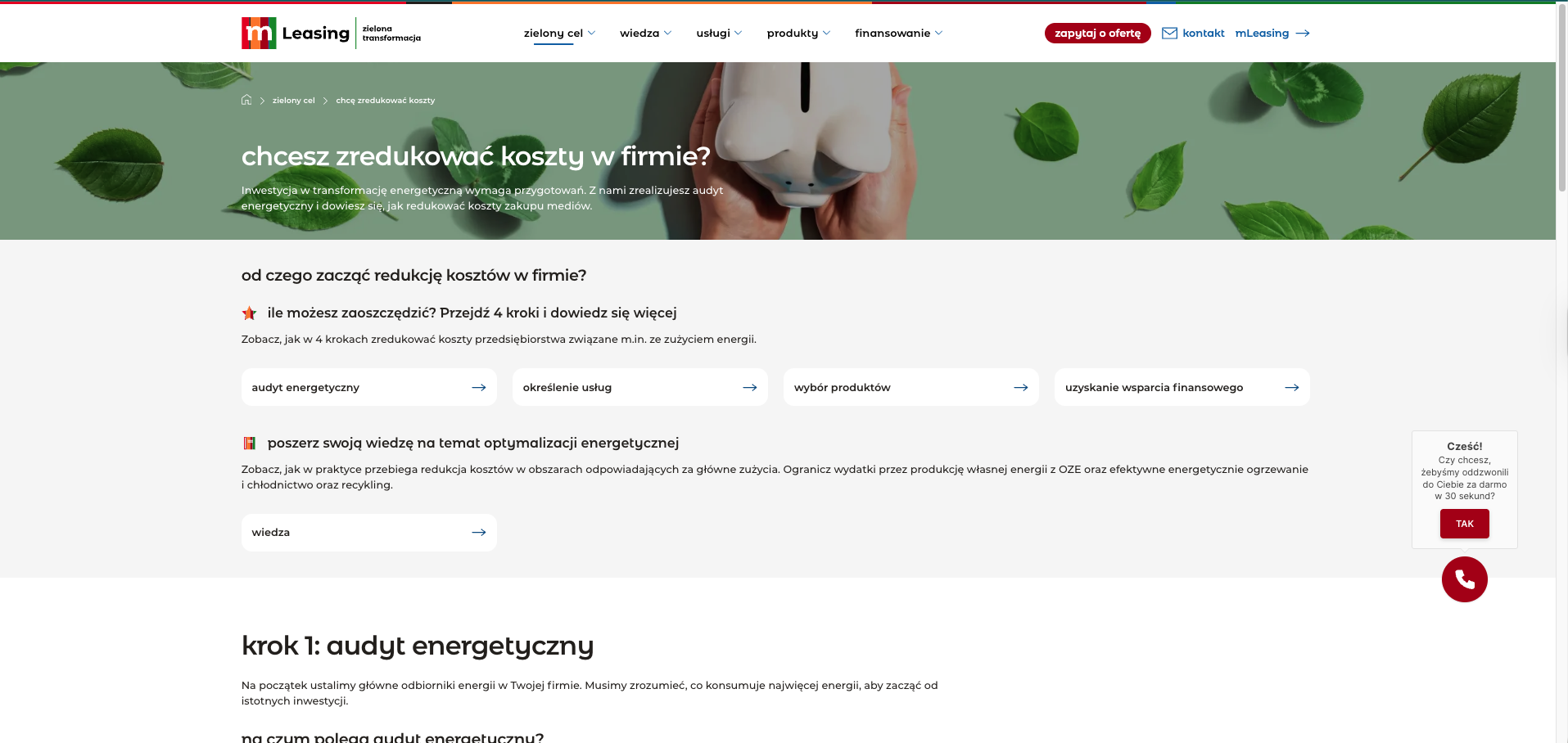
Each path is structured as a four-step process visible up front on the goal page — so the user can see the entire journey before committing. For the cost-reduction path: energy audit → service definition → product selection → financing. For the CO₂ path: calculate emissions → choose a service → choose a product → secure financing. The steps are similar in shape but start from different entry points, because the user’s first instinct is different in each case. A cost-driven company starts with “how much am I spending”; an emissions-driven company starts with “how much am I emitting.”
The solution
The site opens with a single question — what’s your green goal? — and two cards: lower costs, or lower emissions. Each path leads into a structured experience with three layers:
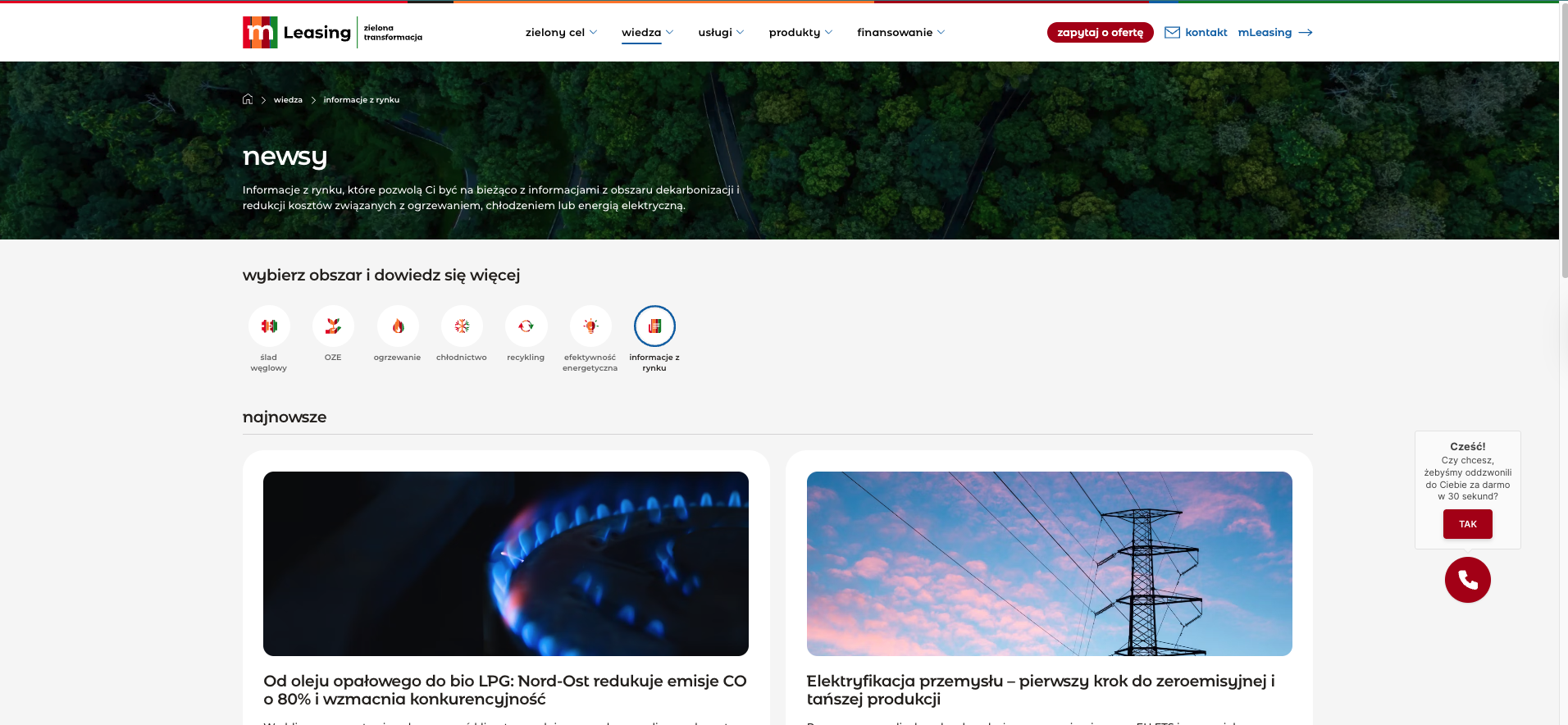
A knowledge layer that explains the category in plain language — carbon footprint basics, photovoltaics, heating, cooling, recycling, energy efficiency, market news — treated like an editorial section rather than a product catalogue. This is what serves the user who isn’t ready to buy yet.
A services layer with the actual offerings — energy audits, white certificates, insurance, EU subsidy support, the CO₂ calculator — each linked to a partner specialist where the client isn’t the sole provider.
A financing layer with the four ways the client can fund the transformation: leasing, loans, BGK guarantees, and EU grants. This is where the path closes — the user has identified what they need and now knows how to pay for it.
The visual language is restrained for a green-tech site. No stock photos of wind turbines at sunset. Real product photography, real charts, real numbers. The aesthetic signals seriousness — these decisions affect a company’s energy bill and its compliance posture.
Outcome
The site is live — mleasing.pl/zielona-transformacja.
The strongest external signal isn’t a metric — it’s commercial endorsement. The product launched with named partnerships from Polenergia Sprzedaż (green-energy supply), ALTO Advisory (decarbonisation plans), and EnMS Polska (energy audits and white certificates), and the client’s leadership has cited the platform in interviews with leading Polish financial publications. For a B2B financial-services product, that’s the validation that matters: serious counterparties associated themselves with it, and the business treats it as a flagship.
What I’d do differently
Looking back with some distance, four things I’d push for in a v2:
- Consolidate the information architecture. Some taxonomies duplicate each other across knowledge and services. Users can land on similar content via different routes, which can erode the clarity of the two-paths model.
- Hard numbers and partner logos above the fold. The site currently earns trust through copy and structure; it should earn it visually in the first second. Partner logos and a concrete impact number belong on the hero.
- Bring the CO₂ calculator on-domain with an outcome preview. Right now the calculator interrupts the path. Inlining it with a live outcome preview would convert more cautiously-curious users into enquiries.
- Case studies as individual stories with quantified outcomes. Logos aren’t enough at this point in the site’s maturity. Each partnership deserves a real story: who, what, how much.
Good designers don’t ship and walk away. The most useful question after launch is what do I now see that I couldn’t see at the start? These four are mine.